
Outbid made $131,851 in 4 days. The auction became the ad.
Outbid made $131,851 and pulled 1.2M visitors in four days by turning a $5 pay-to-rank leaderboard into a public market for attention. Here is the mechanism, and why I built Topboards so anyone with an audience can run their own.
Outbid looked like a joke the first time I opened it.
One input field. Add your website. Pay more than the person above you. Move up.
That's basically the whole product.
But then the numbers got weird.
Within roughly four days, Outbid crossed 1.2 million visitors. An independent crawl on August 22 found 897 listings with $131,851 sitting on the board and more than 210,000 outbound clicks. The current #1 has paid $15,000. (outbid.lol)
I started watching because it was going viral.
I kept watching because it stopped looking like a leaderboard and started looking like a market.
The leaderboard isn't really the product
If Outbid had launched with:
Pay $15,000 to put your startup logo at the top of this page
nobody would care.
The position is worth something because more than a million people came to look.
But those people came because the competition itself was interesting.
Someone takes #1.
Someone pays $1 more and knocks them down.
The founder screenshots it.
Someone else responds.
The bid gets bigger.
The bigger bid creates a better story.
And the story creates more traffic.
The loop is:
traffic → valuable rank → larger bids → spectacle → more traffic
The advertisement doesn't interrupt the content.
The fight for the advertisement becomes the content.
Radical transparency is doing a lot of work
Outbid publicly shows:
- visitors
- bids
- rankings
- outbound clicks
Some top listings have already generated more than 10,000 clicks. (outbid.lol)
That's important.
Traditional advertising asks you to trust the platform.
Outbid says:
Here is the traffic. Here is what everyone paid. Here is how many clicks they received. Here is exactly what it costs to pass them.
You can decide for yourself whether the attention is worth buying.
The visitor counter tells you how big the stadium is.
The bid tells you what someone thinks the seat is worth.
The clicks provide evidence.
Expose all three and the page starts looking less like a directory and more like an exchange.
This is an old idea in a new interface
The underlying mechanism isn't new.
In the late 1990s, GoTo.com, later Overture, let advertisers bid for search placement. Higher bid, higher position. Researchers even documented competitors repeatedly leapfrogging each other by tiny bid increments. (web.stanford.edu)
Pricewatch concentrated buyers onto simple ranked pages where being near the top had real economic value.
The Million Dollar Homepage showed that buying advertising could itself become spectacle: purchases generated press, press generated traffic, and traffic made the remaining inventory more valuable.
Outbid compresses those ideas into something anyone understands instantly:
Pay more. Go higher. Everyone can see it.
And in 2026, people are already trained on public rankings, prediction-market prices, Twitch gifts, creator battles and follower counts.
Money has become another visible score.
The distribution is extremely uneven
The independent Outbid crawl found something important.
Of 897 listings:
- median bid: $5
- 276 listings paid exactly $5
- 617 paid $10 or less
- only 28 paid $1,000+
Yet the board contained more than $131,000. (linkdr.com)
That's a power law.
The long tail creates participation.
The middle creates competition.
A tiny number of whales create most of the revenue.
And everyone who never pays still contributes the thing all the bidders are buying:
attention.
But success creates another problem
At the time I'm writing this, the top positions look roughly like:
- $15,000
- $14,028
- $14,023
- $13,005
- $12,716
- $12,711
- $10,000
Then #8 drops to around $3,500. (outbid.lol)
That's interesting.
The board is still getting new $5, $10 and $20 listings.
But the very top is starting to freeze.
That's the paradox:
More attention makes the position more valuable.
That raises the price.
Eventually the price makes the most interesting positions harder to challenge.
The advertising can keep working, but the game slows down.
Outbid has already introduced a separate rolling Today leaderboard alongside the permanent ranking. That's an early sign that permanent scarcity and renewable competition may need to coexist. (outbid.lol)
Then everyone copied it
Within days, dozens of .lol clones appeared.
Startups. Creators. Football clubs. Memecoins. Videos.
Even leaderboards ranking other Outbid clones.
An August 22 crawl found 61 copycat domains already listed on Outbid. (linkdr.com)
Most had tiny bids and tiny traffic.
Meanwhile Outbid had crossed a million visitors.
That might be the most important lesson:
The mechanism is copyable. The attention isn't.
You can rebuild the ranking logic in an afternoon.
You can't copy 1.2 million people looking at it.
A pay-to-rank board without an audience is just a checkout form.
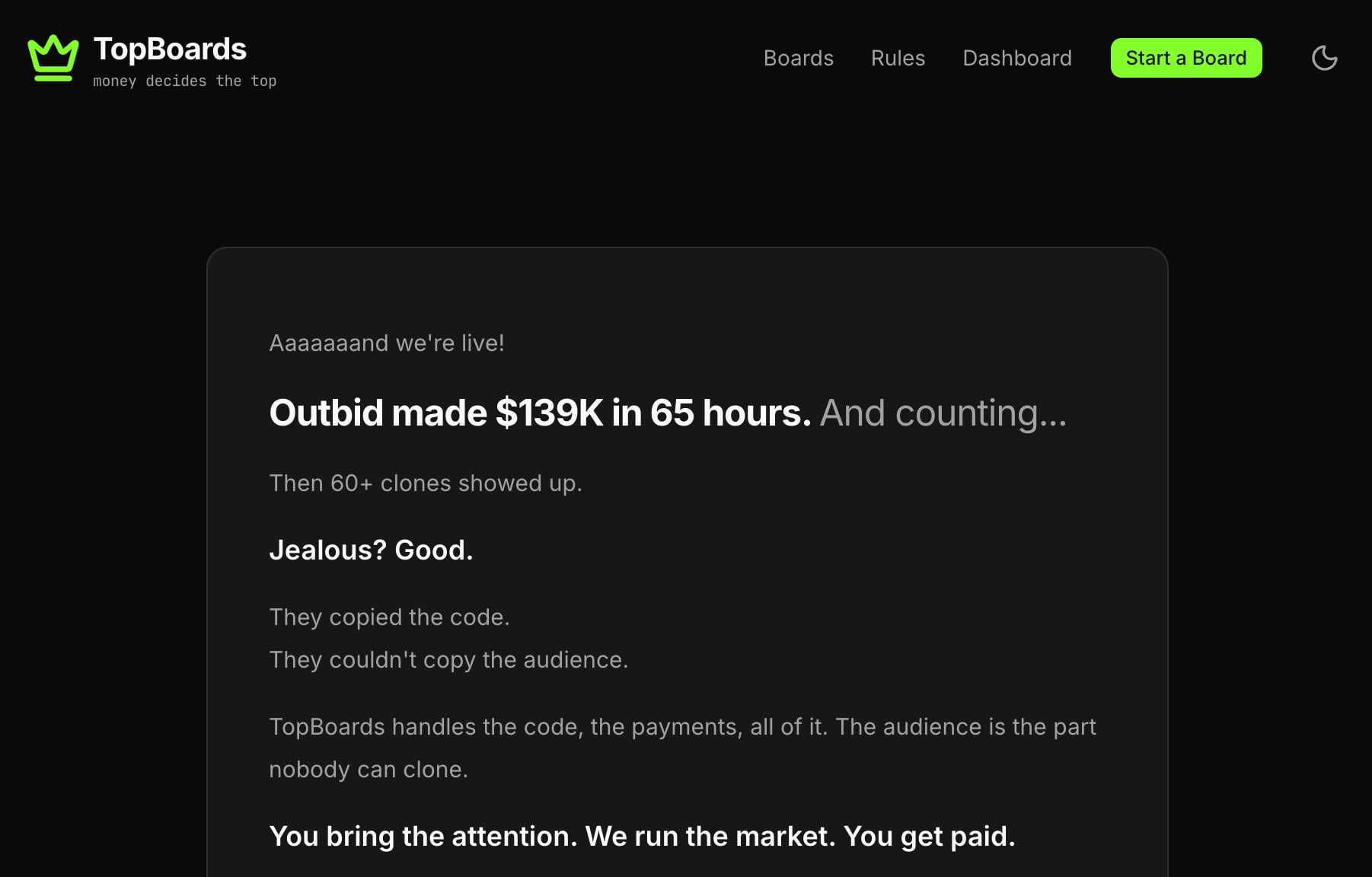
So I built TopBoards
I've spent a lot of time thinking about distribution lately. AI keeps making software cheaper to build. It does not manufacture attention.
Outbid made me realize the loop itself can be a product: a participant pays because an audience exists, that money helps create more audience, more audience makes the rank more valuable, and more value pulls in more competition.
attention → competition → revenue → distribution → more attention
The catch in that first paragraph is the catch in the whole space. A pay-to-rank board without an audience is just a checkout form. Outbid works because Outbid already has the crowd.
But a lot of people already have a crowd. Creators. Founders. Communities. Newsletters. They have attention and no clean way to convert it.
So I built TopBoards to hand them the mechanism.
The idea is simple. If you already have an audience, TopBoards lets you spin up your own board in minutes. Your audience competes for the top spot in public, you turn attention you already have into revenue, and everyone can see the traffic, the bids, and the clicks, exactly like Outbid.
Outbid proved one board can pull a million people. TopBoards is the tool for running your own.
A creator can have a board. A community can have a board. Anyone sitting on attention can turn it into a live, visible market instead of letting it sit idle.
Will it work?
Outbid may simply be the perfect viral object for Startup Twitter. Founders understand advertising. Founders love rankings. Founders screenshot revenue. Founders copy things immediately. It could be the Million Dollar Homepage of 2026.
Or Outbid exposed a broader advertising primitive: public rank + public money + public performance + visible competition. If that works across unrelated audiences, the interesting company isn't one leaderboard. It's the infrastructure behind many of them.
That's what I'm testing with TopBoards. And the nice part is we won't have to argue about whether it works for long. The traffic can be public. The clicks can be public. The money can be public.
If you have an audience and want to turn it into a board, come build one: topboards.lol
Get the next post in your inbox
New essays on founder-led growth, as they publish. No spam, unsubscribe any time.