
I priced distribution for an autonomous AI agent. None of the paths close at SMB ARPU.
Inference costs are dropping. Data is gated but the buying signals are already public. Distribution is the constraint with no roadmap: cold channels are closing and paid acquisition doesn't close the math at $57 ARPU. So full autonomy is the wrong target, and the winning move is autopilot into the conversations already happening.
This is post 4 in the series on the autonomous-AI-runs-your-company thesis. Post 1 laid out the three constraints. Post 2 priced inference. Post 3 priced data. Both have honest roadmaps to "this gets better": inference on the 10x/year price curve, data through the public buying signals already being broadcast in the open.
Distribution doesn't have a roadmap. That's what this post is about.
The CEO of a $250M-valued autonomous-agent platform said it most clearly on a live demo I sat through: "Distribution is bought, full stop." I think about that sentence a lot. It's the most honest thing anyone has said about AI agents in 2026, and it quietly admits the constraint that no autonomous-agent founder pitches you on, because the honest version doesn't have a hopeful ending.
The paid-acquisition math at SMB ARPU
Let's price the easy path first: just buy customers through Meta Ads.
2026 Meta Ads benchmarks for B2B SaaS, per the recent vertical breakdowns:
- Bootstrapped startup CPA: $40–$80
- Funded startup CPA: $60–$120 (you have more budget, you bid more aggressively, costs rise accordingly)
- CPL on Lead Ads: $80–$220
- Cost per SQL: $400–$2,400 depending on ACV tier
For an autonomous-agent product at the $57/mo ARPU benchmark we've been using, customer lifetime value at the disclosed 50% month-one churn rate works out to roughly $80-$150 (post 1’s stricter read, with churn continuing, puts it at $57-114) over the cohort's life (a discounted geometric series tail; assumes churn flattens after the first month, which is generous).
LTV-to-CAC math, best case:
- LTV: $150
- CAC: $40 (bootstrapped lower bound)
- LTV:CAC: 3.75x, looks OK on paper
LTV-to-CAC, realistic case:
- LTV: $100
- CAC: $80
- LTV:CAC: 1.25x. Broken
Even in the best case, you still haven't paid for the ~$27/month of inference (from post 2) or ~$50/month of prospect data (from post 3) the agent burns per active user. So at $150 LTV, you've earned $150 from the customer and spent roughly:
- Inference over the lifetime: ~$35 × 2 months effective = $70
- Data over the lifetime: ~$50 × 2 months = $100
- CAC: $40
- Total: $210 spent against $150 earned. Underwater by $60 per customer.
This is the math the autonomous platform discloses without quite naming it. Roughly 40% of their disclosed monthly revenue goes back into Meta Ads ($157K on $396K MRR). The other 60% gets eaten by inference and data and the founder's runway. The raise isn't growth fuel; it's bridge financing across the constraint stack.
Cold outreach as the alternative, and why the channels are closing
The autonomous workaround to Meta Ads is cold outreach. The pitch: skip paid acquisition, use the agent to scrape prospects and send at scale. The platform I keep citing disclosed sending ~1,099 emails per day across thousands of customer-company inboxes at {slug}@theirplatform.app. Do the math: under one email per inbox per day. That's not cold outreach. That's a vanity number. The founder admitted as much on the same demo: "5 emails per day from a single inbox is noise, not a channel."
So volume can't scale through cold email at autonomous-agent shapes. What about the other cold channels?
X (Twitter) restricted programmatic cold-reply APIs in 2026 specifically to combat LLM-generated reply spam. The current restriction: a reply can only be sent if the author of the original post follows you or has mentioned you. Cold replies (the entire premise of "AI agent scrolls X and responds to relevant posts") return 403 errors. The agent can scroll; it cannot send through the API. This isn't a temporary throttle; it's a structural policy change to defend conversation quality against exactly the autonomous-volume pattern that "AI runs your company" promises.
LinkedIn's TOS prohibits automated access and they enforce. The autonomous platforms doing LinkedIn outreach all use browser-automation workarounds, and account restriction is constant and routine. Notably: the platform I keep citing acknowledged on the demo that the platform-ban risk gets transferred to the customer's sub-company accounts, with TOS language that isn't "buttoned up." That's not a moat; that's a liability waiting to ripen.
Reddit became structurally hostile to automated outreach. Years-old accounts get banned for posting patterns the filter reads as promotional (the mechanics, in post 1). Reddit doesn't read content quality; it reads behavioral pattern. Autonomous volume is the pattern.
Cold email deliverability collapses on shared root domains. The autonomous architecture of "one inbox per customer-company, all under theirplatform.app" means one bad sub-company nukes deliverability for all of them. The platform's founder acknowledged this is a known gap, with per-company custom domains "in the pipeline" rather than shipped. Until that ships (and even after, until each sub-domain is independently warmed) the cold-email channel is a Russian-roulette deliverability bet.
Every cold channel is closing or already closed for autonomous-volume operators. The platforms aren't returning to the open-firehose era. The forcing function is exactly the same low-effort AI-generated outreach the autonomous-agent pitch promises to send.
What remains, and why an autonomous agent can't have it
Strip out paid (math doesn't close), strip out cold (channels closing or closed), and the distribution channels left are:
- Content and SEO: works, takes 12-24 months, requires consistent voice and substance
- Community embedding: works, requires showing up daily with judgment, taste, and helpfulness
- Founder-led brand: works, compounds for years, requires a founder
- Partnerships and integrations: works, requires relationships and judgment
Every one of these requires a human face and patient relationship-building. The autonomous agent's "I'll run your whole company" pitch structurally cannot manufacture this layer at the start of a company's life. There's no audience to compound on yet. There's no brand for the algorithm to amplify. There are no warm relationships to ask for distribution.
The autonomous pitch tries to solve this with subdomain branding ("every customer company gets a subdomain on our platform → free distribution"). The platform's founder admitted on the same demo: "Honestly, nobody stumbles onto a random subdomain." Subdomain branding is a vanity layer, not a distribution channel.
What's left is paid distribution (which loops back to the math problem above) or patient organic distribution requiring a human face, which the autonomous pitch structurally cannot do at scale across thousands of customer-companies.
Why distribution has no roadmap
Here's the structural difference between constraint C and the other two:
- Constraint A (inference) has a price-drop curve. It dissolves in 12-24 months for cost-disciplined builders.
- Constraint B (data) has an architectural bypass. The buying signals are already public, and reading them changes the equation.
- Constraint C (distribution) has neither. Cold channels are closing. Paid channels don't close the math at SMB ARPU. Organic channels require a human face that an autonomous agent structurally cannot manufacture.
You can wait for cheaper inference. You can read the buying signals that are already public. There is no equivalent "wait" or "build" move that opens distribution back up for autonomous-volume operators. The forcing functions are intentionally pushed by the platforms themselves to defend conversation quality, and they're trending more aggressive, not less.
The verticals where the autonomous-agent thesis genuinely works in 2026 are the ones where distribution is already solved by something other than the agent:
- Consumer apps where paid Meta/TikTok is the only acquisition path: the agent operates within the existing paid-acquisition system, doesn't have to manufacture distribution.
- Embedded distribution plays: the agent lives inside an existing channel (Shopify app, Slack integration, Notion plugin) where distribution comes from the host platform.
- Brand-driven categories where the celebrity halo of the founder does the work, which requires a founder, which means it's not actually autonomous.
For the general-case "AI builds and runs any business" framing, distribution is the load-bearing wall. There is no autonomous version of it that scales at SMB ARPU. None of the autonomous-agent platforms currently in market have produced one.
The move that actually closes the math
Stack the three constraints from this series:
- Inference at $25–60/user/month (dissolves on the price curve over 24 months)
- Data at $50–300/user/month if paid, or near-free if you read the buying signals already in the open
- Distribution at $40–120 Meta CAC plus the broken LTV ratio, or organic that needs a face
Full autonomy is the wrong target at SMB economics. Not because the work is too hard to automate, but because the math only closes when the expensive, account-burning grind gets automated and a human stays on the one input that compounds: judgment.
So here is the move. Distribution can't be manufactured, but it can be found. The buyers are already out there, today, asking the exact question your product answers: on Reddit threads, in X replies, in LinkedIn comments. That demand already exists. The grind is finding it across every channel, drafting a reply in your actual voice, and pacing the sends so your accounts don't get banned. That grind is what should run on autopilot.
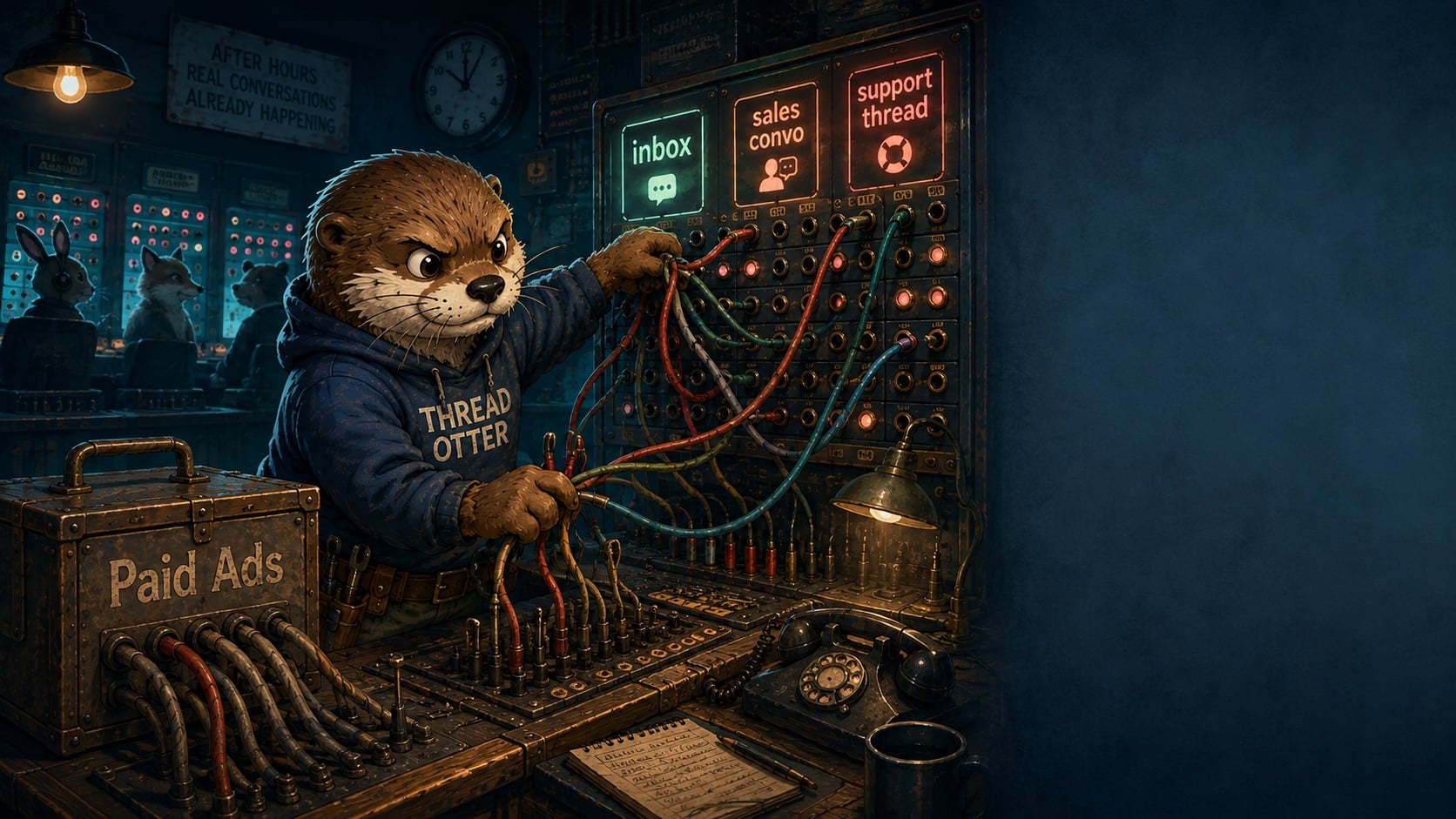
That's the architecture worth building, and it's exactly what we're building at Thread Otter: autopilot that puts you in the conversations already happening, surfaces the people already raising their hand, and drafts in your voice so you ship in seconds instead of hours. The founder sets the voice and the bar; the agent runs the grind inside those guardrails, because that is where the leverage is. Everything underneath runs while you sleep, and what lands in your inbox is leads and customers.
The autonomous platforms are still buying their way across a constraint that doesn't dissolve. We'd rather put you where the demand already is.
This is post 4 of a 5-part series on the AI-runs-your-company thesis. Start with post 1 for the full audit.
Get the next post in your inbox
New essays on founder-led growth, as they publish. No spam, unsubscribe any time.